10 Benefits of Having a Website for Your Business
Credibility, easy contact, control of your message and more. Ten practical reasons a website earns its place in a small business, with examples from different industries.
Think about the last time someone recommended a business to you. A cleaner, a mechanic, a caterer, a consultant. Before you phoned them, there is a good chance you looked them up. You wanted to see what they do, whether they look reliable, and how to get hold of them.
Your customers do exactly the same thing. Word of mouth still brings people to your door, but it no longer ends the conversation. The recommendation gets them to search for your name, and what they find (or don't find) decides whether they contact you or move on to the next option.
When a potential customer searches for your business and finds nothing, or only an out-of-date social media page, they are left guessing. Are you still operating? Do you cover their area? Is this a proper business or a side project? Many people will not go to the trouble of finding out. They will simply contact someone who is easier to check.
A professional website gives you control over that first impression. It puts the essentials in one place: who you are, what you do, where you work and how to contact you.
A clear, well-designed website tells people you take your business seriously. That matters most where trust is part of the purchase: someone letting you into their home, handing over their car, booking you for an event or sharing sensitive business information. A neat site with proper contact details reassures them before they have spoken to you.
Most business owners answer the same handful of questions every week. What do you offer? Which areas do you cover? What are your hours? How do I book? Put those answers on your website and you save time on every call, while customers who only need a quick answer get it without waiting for you.
You cannot answer the phone during a job, a meeting or a family dinner. Your website can still do part of the work. Someone browsing at 9pm can read about your services, see your contact options and send you a WhatsApp message to pick up in the morning.
A social media page is a good tool, and we would not tell you to abandon it. But it is not the same thing as a website. On a social platform, someone else decides how your page looks, who sees your posts and what happens if the rules change. On your own website, you decide. We compare the two properly in Website vs Facebook Page: Which Does Your Business Need?
A professional website is not about flashy animations. It comes down to a handful of practical things:
Many owners put off getting a website for one of three reasons. It seems expensive, it seems slow, or it seems like something they will have to figure out themselves. All three used to be fair concerns. A traditional custom build can cost thousands of rands upfront and take weeks, and once it is live someone still has to host it and keep it updated.
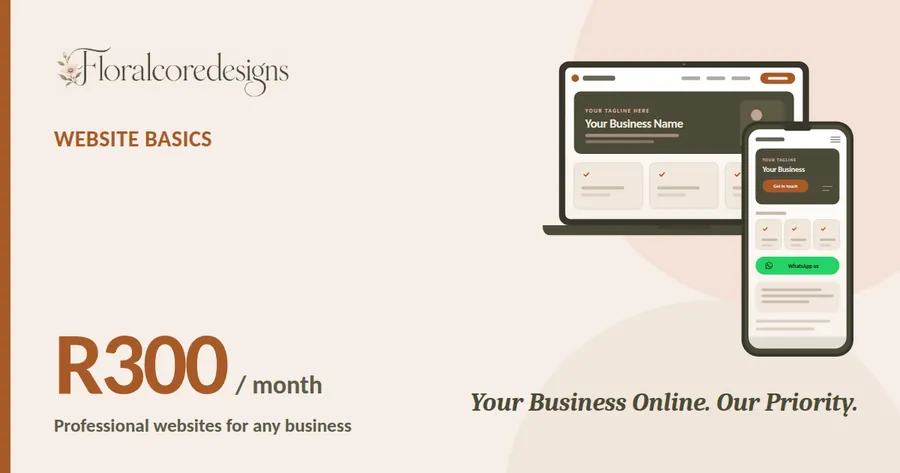
That is why monthly website subscriptions have become popular with small businesses. Instead of paying a large amount upfront, you pay a flat monthly fee that covers the design, hosting, maintenance and support. We break down the numbers in How Much Does a Professional Website Cost in South Africa?
Any business that wants customers to find and contact it. That includes plumbing and electrical businesses, construction and renovation companies, cleaning services, automotive workshops and detailers, beauty salons and barbershops, restaurants and caterers, consultants and other professional service providers, and everything in between. The details of the site change from one industry to the next. The reasons for having one do not.
You do not need to write a brand strategy. To get a first version of your website built, you mostly need the basics you already know:
If you would like a step-by-step walkthrough, read How to Get Your Small Business Online Quickly and Affordably.
A website will not replace good work or a good reputation, and it is not a magic switch that creates customers overnight. What it does is make sure that when someone hears about you and goes looking, they find a business that looks professional and is easy to contact. In 2026, that is a small investment for something that works for you every day.
Keep reading
Credibility, easy contact, control of your message and more. Ten practical reasons a website earns its place in a small business, with examples from different industries.
A Facebook page and a website do different jobs. Here is a fair comparison of control, cost, trust and reach, and how most small businesses use both.
A simple seven-step plan for getting a small business online without a big budget or months of waiting: what to prepare, how to choose a builder, and what to do after launch.